Track Leads from Yard Signs: Home Services Guide (2026)
Tired of guessing which signs work? Learn to track leads from yard signs with a simple system. See your real ROI and stop wasting money on dead zip codes.
 FieldLine Team17 min read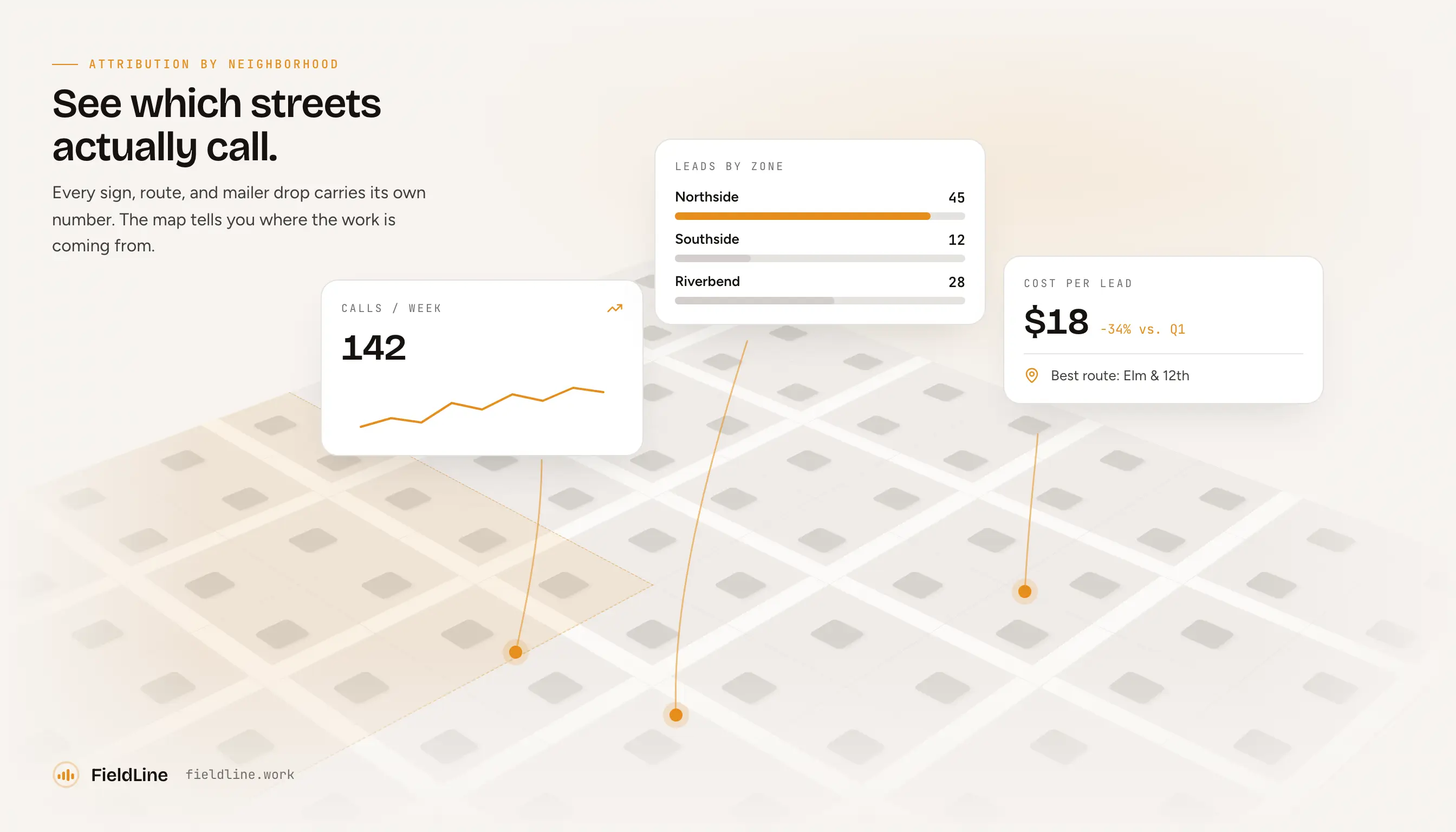
You pull the truck into the driveway at 6:42pm after a long shift in a dusty crawlspace. The phone rang four times while you were wrestling with a Carrier furnace. You know those calls came from the neighborhood where you planted ten new boards this morning. You just don't know which ones. It is nearly impossible to track leads from yard signs when you are focused on the job. You end up guessing which zip codes deserve more spend and which ones are just wasting your plastic.
Most owner-operators treat yard signs like a silent prayer. You pay the print shop, stake them in the dirt, and hope the phone rings. It's a frustrating way to run a business. You deserve to know exactly which sign turned a passerby into a customer. This guide will show you how to stop the guesswork. You'll learn to measure your real ROI with a simple, zero-app tracking system that works from your tailgate. We will cover how to use dedicated numbers and AI lead cards to capture every detail without touching a piece of paper.
Key takeaways
- Identify which neighborhoods actually ring your phone. Stop wasting money on dead zones.
- Use dedicated local numbers to track leads from yard signs. No new apps or hardware required.
- Learn why high-value homeowners prefer calling. Avoid the friction of QR codes.
- Convert every call into a structured lead card. AI transcription works while you are on the job.
- Launch your tracking system in under two minutes. Use the phone already in your pocket.
Table of Contents
The yard sign blind spot: why most contractors waste their ad spend
Yard sign lead tracking is the process of linking a specific incoming call to the exact physical sign that triggered it. For most contractors, this is a massive blind spot. You spend hundreds on corrugated plastic and stakes. You spend hours driving around neighborhoods. But when the phone rings, you have no idea if that caller saw your sign on a corner or found you through an expensive search ad. If you want to track leads from yard signs effectively, you have to stop guessing.
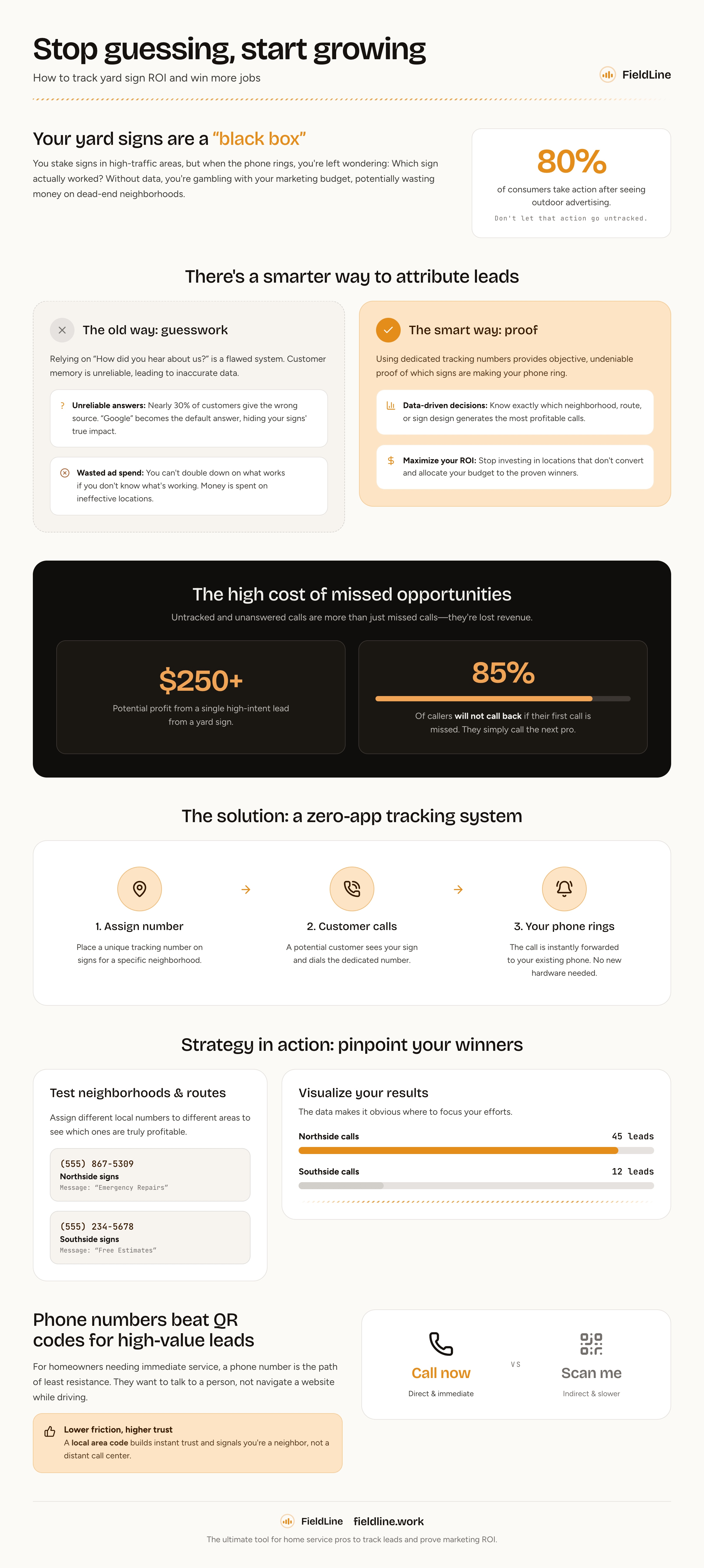
This lack of data leads to wasted marketing spend. You might keep buying signs for a neighborhood that produces zero revenue while ignoring a high-performing area. To fix this, you need to move from soft attribution to hard attribution. Soft attribution is a guess. It is a technician scribbling "saw sign" on a work order. Hard attribution is a data point. It's a recorded call tied to a specific tracking number used only for those signs. Without this, your lead generation strategy is just a series of expensive experiments.
The "who referred you" problem
Relying on your customers to tell you where they found your number is a mistake. Homeowners are often distracted. They might be standing in a flooded basement or staring at a thermostat that won't kick on. When you ask how they heard about you, they give the easiest answer. Statistics show that customers provide the wrong referral source roughly 30% of the time. "Google" becomes the default answer for everyone, even if they saw your sign five minutes ago. This friction during the booking process makes your data useless. You end up overfunding digital ads while your physical marketing does the real work in the background.
The cost of unanswered sign leads
Leads from yard signs carry higher intent than almost any other channel. These people aren't just browsing. They saw your name on a neighbor's lawn. They trust you because you are already working in their zip code. But that trust has a short shelf life. If you miss the call because you're under a sink or up a ladder, the lead usually vanishes. About 85% of callers will not call back if they hit a voicemail. They simply move to the next contractor on the list. In the home services world, you have a five-minute window to capture that interest. Every missed sign lead represents $250 or more in lost potential revenue. If you can't track leads from yard signs, you can't see how much money is slipping through your fingers while you are on the clock.
Dedicated tracking numbers: the only way to attribute sign leads
Most contractors use their main business line for everything. This is a mistake. When you use one number for your website, your truck, and your yard signs, you lose all visibility. A dedicated number solves this. It acts as a filter. Call Tracking works by assigning a unique phone number to a specific marketing asset. When that number rings, you know exactly where the lead came from before you even say hello. It is the most reliable way to track leads from yard signs because it removes the human error of asking for referral sources while you are standing on a tailgate or finishing a job.
These tracking numbers do not require a second phone or a complicated app. They forward directly to your existing cell phone. You can keep your personal number private while still answering every business call on the go. There is no new hardware to buy and no software for your techs to learn. It is a simple tool designed for a busy life in the field. Using separate lines for your physical marketing allows you to see your ROI in black and white.
One number per neighborhood or route
You can get specific with your tracking to maximize your budget. Assign one number to signs in the north side of town and another to the south. After a month, look at the call logs. You might find that one neighborhood produces twice the leads for half the sign spend. When you track leads from yard signs using separate numbers for different zip codes, you stop wasting money on dead zones. You can even test different sign designs. Put a "Free Estimate" sign on one street and an "Emergency Service" sign on the next. Unique numbers tell you which message actually stops traffic. For specialists, implementing HVAC marketing tracking across different service routes allows you to focus your crew where the high-margin jobs are actually located.
Local vs. toll-free: what works for trades?
Homeowners want a neighbor, not a corporation. A local area code on a yard sign builds immediate trust. It says you are part of the community and probably just down the road. Toll-free numbers often feel disconnected or like a high-pressure sales line. In the trades, that local connection is your biggest asset. You can secure a local US number in seconds and start using it on your next batch of signs. It is a low-cost way to ensure your phone keeps ringing with high-intent leads from people who recognize your area code. If you are ready to see which of your signs are actually working, picking a local number is the first step toward real marketing clarity.
QR codes vs. tracking numbers: which actually gets the call?
QR codes are appearing on everything from menus to billboards. They seem like a high-tech way to bridge the gap between a physical board and your digital presence. But for a service business, they often create a friction gap that stops a lead cold. If your goal is to track leads from yard signs, you have to prioritize the fastest path to a conversation. A phone number is a one-tap action. A QR code is a multi-step process that many high-value customers simply won't perform.
Direct connection is the lifeblood of the trades. When a customer sees your sign, they are usually looking for a solution to a specific problem. Every extra second they spend fumbling with their phone is a second they might spend reconsidering or looking at a competitor. While QR codes offer a way to link to a website, they often bypass the most important part of the sales process: the human voice.
The problem with QR codes on the move
Drivers are your primary audience for yard signs. They are moving at 25 or 35 miles per hour. They cannot safely scan a code while steering. Even if they are walking a dog, scanning requires them to stop, pull out a phone, open the camera, and wait for a link to load. In low light or from a distance of twenty feet, most phone cameras struggle to lock onto a small code. These technical hurdles kill the momentum of a high-intent lead. QR codes work well on door hangers or invoices where the customer is stationary. On a sign, they are often just wasted space.
Why customers still prefer calling for service
Homeowners facing an emergency don't want to fill out a web form. If a pipe bursts or a Carrier furnace stops at 11:00pm, they need immediate reassurance. A phone call provides that. It builds trust faster than any landing page ever could. When a customer calls a dedicated tracking number, you capture their voice, their tone, and the specific urgency of their problem. This allows for better sales qualification on the spot. Sending that same lead to a website gives them a chance to get distracted by a text message or a social media notification. A direct call keeps them focused on booking the job with you.
Demographics also play a role in how you track leads from yard signs. Older homeowners often control the largest maintenance budgets. This group frequently views QR codes as a nuisance or a security risk. They prefer the reliability of a local number. By forcing a digital interaction, you might be filtering out your most profitable callers. A tracking number serves every demographic perfectly. It is visible, familiar, and requires zero technical skill to use. You get the data you need without making your customers jump through hoops.
Setting up your sign tracking system in 5 minutes
Setup shouldn't take all morning. You have jobs to bid and crews to manage. A tracking system only works if it stays out of your way. You can start to track leads from yard signs in five minutes without downloading a single app. It is a straightforward process that turns your physical marketing into a data-driven machine.
- Step 1: Secure a dedicated local number. Choose a number with the same area code as your service city to maintain a neighborly feel. This keeps your personal line clean.
- Step 2: Set the forwarding. Point the new number to your existing cell or your dispatcher's phone. No new hardware or VoIP headsets are required.
- Step 3: Print the number. Use high-contrast colors like black on yellow. If your area code is well-known, focus on making the last seven digits as large as possible. This makes it easier for a driver to memorize in three seconds.
- Step 4: Deploy. Stake the signs at job sites and busy corners. Do this while your techs are loading the truck at 7:12am.
- Step 5: Audit. Check your call logs on Friday afternoon. See which source produced the most high-intent calls.
Assigning numbers to specific technicians
If you run a crew of five, give each tech their own tracking number. This turns your team into a marketing force. While your tech is finishing a Carrier furnace install, they can stake a sign in the front yard. You can see exactly which tech is consistently placing signs and which ones are leaving them in the back of the van. It allows you to reward performance based on real lead generation rather than just labor hours. For owners focused on plumbing lead management, this data is the difference between a tech who just turns wrenches and one who helps grow the business. You get clear proof of who is actually contributing to the pipeline.
Distributing signs strategically
Not all dirt is equal. Use one number for signs placed at active job sites and a different one for signs on busy intersections. This tells you if your curbside marketing is more effective than general neighborhood saturation. You don't need a complex CRM or a data scientist to read these results. A simple call log shows you the source of every ring. If the intersection number stays silent while the job site number blows up, you know exactly where to put your next batch of plastic. You stop guessing and start investing in what works. This is the simplest way to track leads from yard signs without adding office work.
Choose your tracking numbers and start measuring ROI today
Beyond tracking: turning sign calls into lead cards
Knowing which sign worked is step one. Managing the call while you are head-first in a crawlspace is step two. Most tracking tools just give you a list of numbers. You still have to listen to the recording to find out what the customer actually needs. That is a waste of your time. You need a system that converts a raw phone call into a structured piece of data automatically. It turns a ringing phone from a distraction into a documented lead that you can act on when your hands are free.
AI transcription for busy crews
When you track leads from yard signs, the phone often rings at the worst times. You are wrestling with a Carrier furnace or driving to the next site. AI transcription handles the heavy lifting. It listens to the call and extracts the caller's name, service address, and the specific problem they are facing. It identifies urgency by listening for keywords like "leak" or "no heat." Instead of a twenty-minute recording like you might find in a CallRail dashboard, you get a 2-3 sentence summary. You can review the sentiment and urgency of a lead without ever hitting play. It allows you to prioritize high-margin emergency jobs over routine maintenance requests while you are still on the clock.
The zero-app workflow
Your techs won't use a system that requires a new login or a complicated dashboard. They have enough to do. The best way to track leads from yard signs is through a workflow that stays out of their way. Leads are delivered directly to your phone as simple text notifications. You get a lead card that looks like a message from a friend. It contains everything you need to know to book the job. This "zero-app" approach ensures that your team actually follows the process. You keep your personal cell number private by using your dedicated tracking lines for all outgoing callbacks. It creates a professional barrier between your work and your life.
Small crews don't need a bloated CRM. They need a phone line that acts like a digital assistant. This technology is included in every plan, starting with the Starter tier at $35/mo. AI transcription and lead cards are part of the package from day one. You can check out FieldLine pricing for all-in-one AI features that fit your specific crew size. It is a specialized instrument built for the way you already work. You get the clarity of a marketing agency with the simplicity of a flip phone. Stop listening to recordings and start reading lead cards.
Stop guessing and start growing your routes
You don't have to keep driving blind. Yard signs are a powerful tool when you have the right data. By using dedicated local numbers, you finally see which street corners and job sites are paying for themselves. You stop the guessing game and start investing in the neighborhoods that actually keep your crew busy. It is time to move past unreliable intake questions and the "Google" referral trap that masks your real lead sources.
Setting up a professional system to track leads from yard signs takes less than two minutes. You get AI lead cards that capture every name and address while you are wrestling with a Carrier furnace or finishing a repair. Every tier includes these features with no credit card required for your trial. There is no new hardware to buy and no app for your techs to learn. It is a simple way to bring order to the chaos of field operations.
Start your 7-day free trial with FieldLine and track your signs today
Take control of your marketing budget before your next batch of signs goes out. You have the tools to build a more efficient business starting right now.
Frequently asked questions
Keep reading
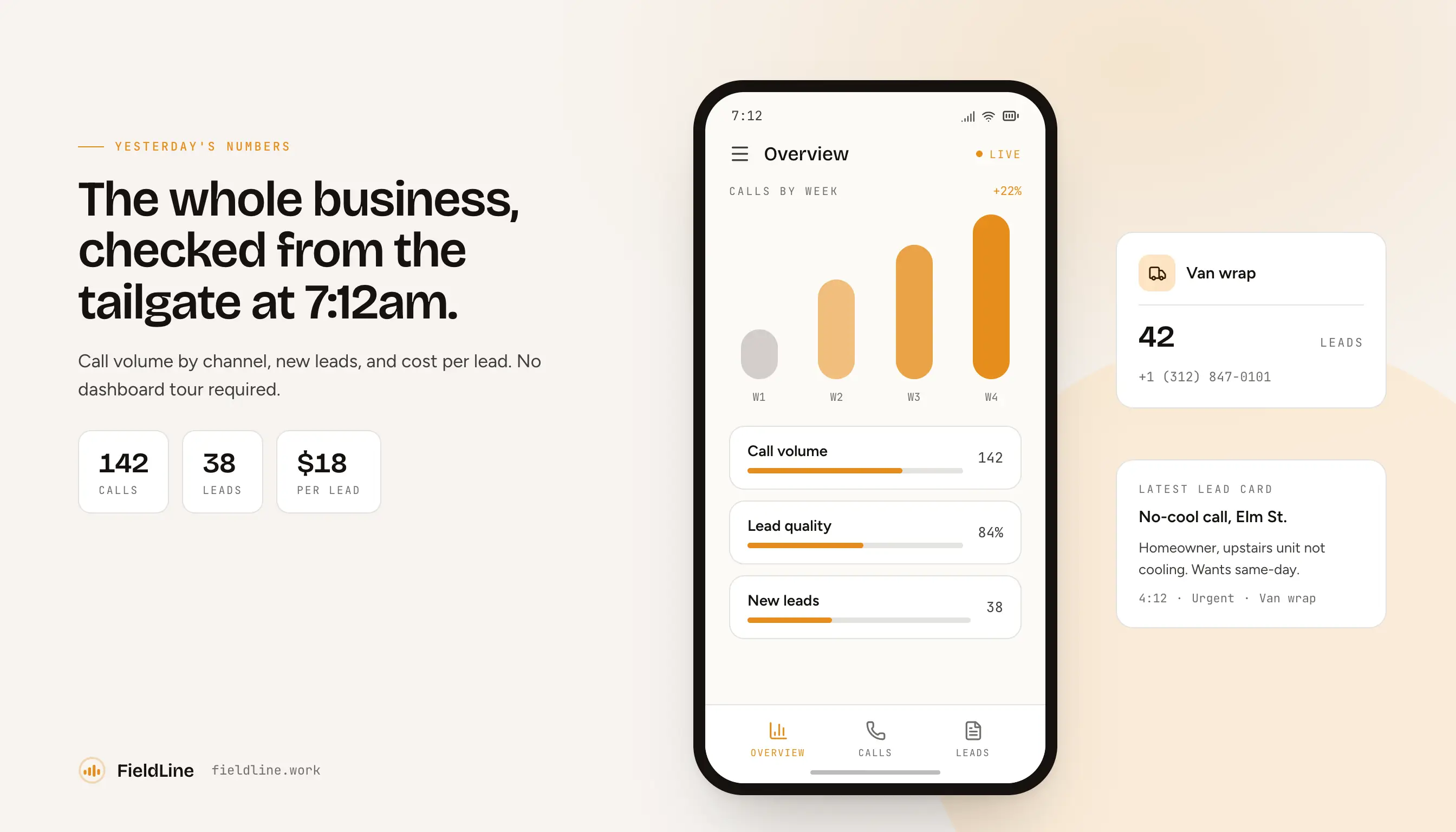
Local Tracking Numbers: A Guide for Contractors
Stop guessing which ads work. This guide shows how local tracking numbers for service business ops reveal your best leads from van wraps, signs, and Google ads.
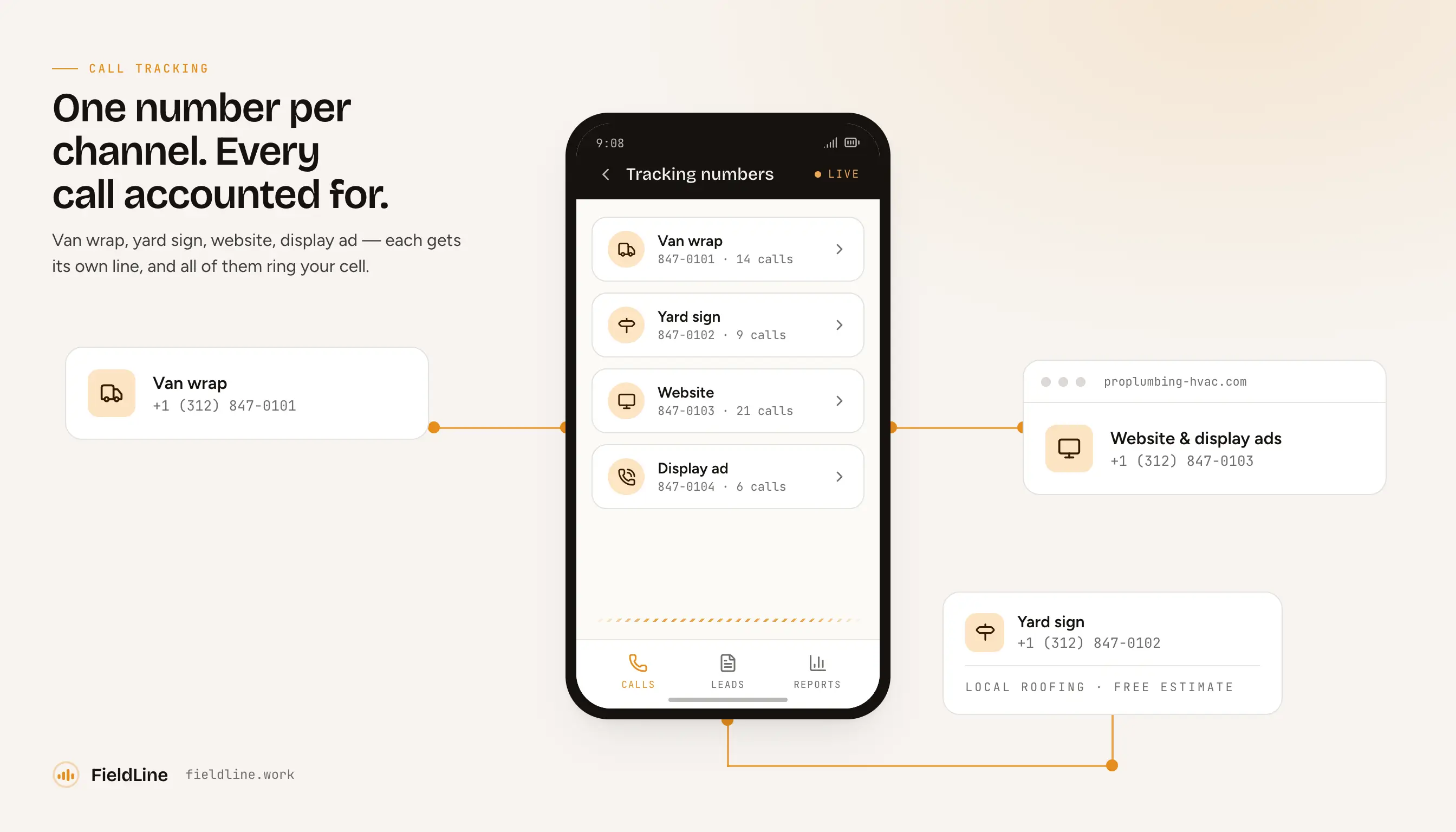
HVAC Advertising Tracking Numbers: Stop Wasting Your Ad Budget in 2026
Stop guessing if your ads work. Use hvac advertising tracking numbers to see which campaigns drive calls and prove your ROI. Capture every lead, even in a cr...
Stop guessing which calls turned into jobs.
FieldLine gives every channel and every tech their own number, records and summarizes each call, and turns it into a lead card you can act on. 7-day free trial, no card required.