Local Tracking Numbers: A Guide for Contractors
Stop guessing which ads work. This guide shows how local tracking numbers for service business ops reveal your best leads from van wraps, signs, and Google ads.
 FieldLine Team15 min read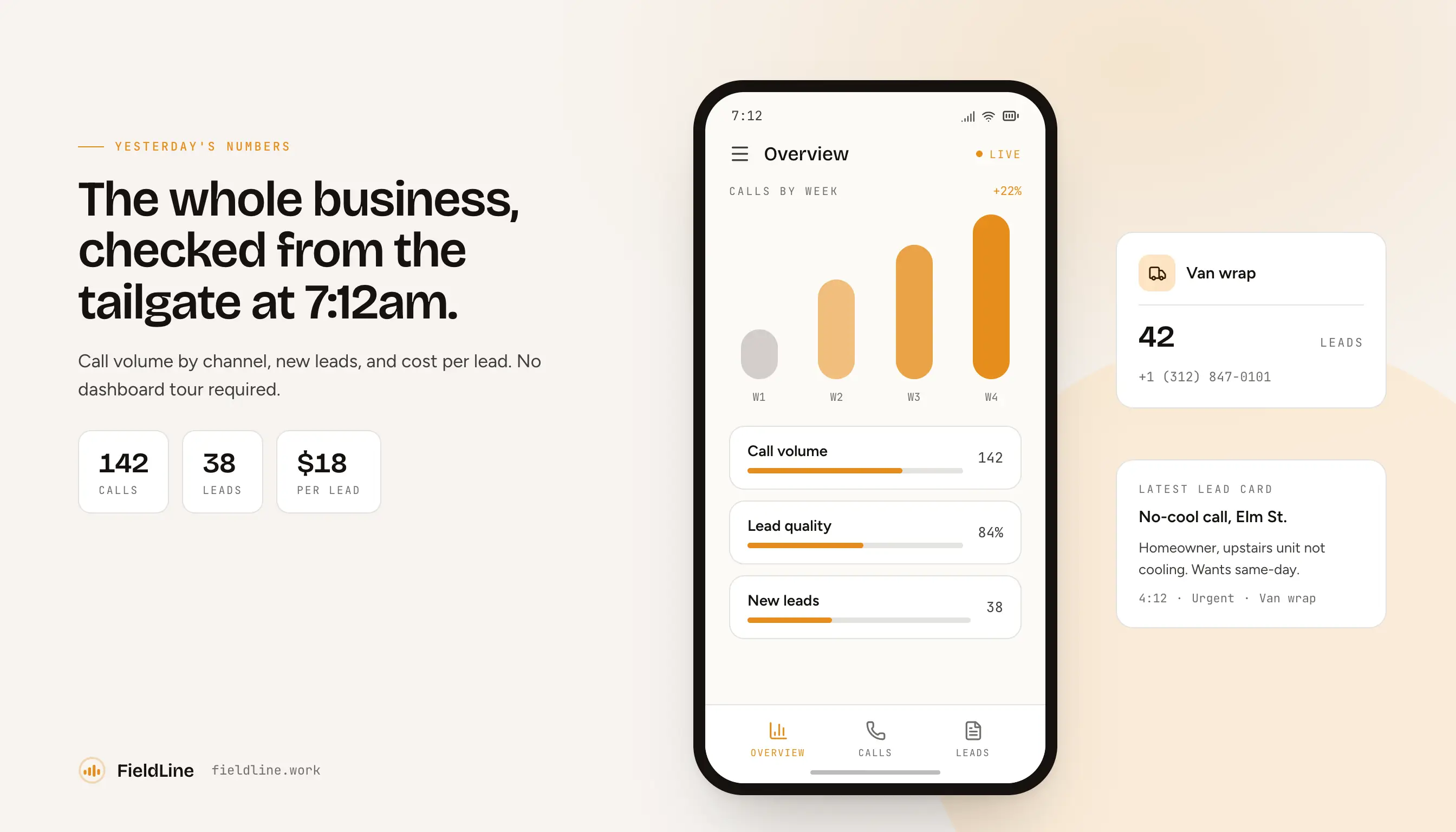
It is 7:12am. You are looking at a cracked heat exchanger on a Carrier furnace in a tight crawlspace. Your phone vibrates on the tailgate of the truck. It might be a lead from a Google ad. It could be a neighbor who saw your van wrap. You have no way of knowing. Research shows that 27% of calls in home services go unanswered. Using local tracking numbers for service business operations stops the guessing game. You are spending money on marketing without a map. It is frustrating to wonder which ads actually work.
You know that every dollar spent on a dead-end ad is a dollar taken away from your profit. This guide will show you how these tracking numbers reveal exactly which ads are working and which ones are wasting your money. We will walk through the process of assigning dedicated numbers to your yard signs, vehicle wraps, and digital campaigns. You will learn how to use call tracking software to capture every lead automatically so you can focus on the job instead of your budget.
Key Takeaways
- Differentiate marketing tracking from shipping updates. Assign unique numbers to specific assets to identify exactly which ad generated the lead.
- Use local tracking numbers for service business marketing to see which campaigns pay for the truck's gas. Stop guessing if your van wrap or Google ad is doing the heavy lifting.
- Prioritize local area codes over toll-free numbers. Neighbors are more likely to answer a call from a local pro who looks like they are just around the corner.
- Capture every lead without downloading new apps or buying hardware. AI transcriptions and lead cards keep your job site organized while you focus on the repair.
- Deploy a simple tracking system in minutes. Assign dedicated lines to your top lead sources and stop wasting money on marketing that doesn't ring the phone.
Table of Contents
What are local tracking numbers for service businesses?
Most contractors hear "tracking number" and think of a USPS barcode on a box of copper fittings. That is for shipping. You need local tracking numbers for service business marketing instead. It is a dedicated phone line assigned to one specific place where you advertise. You put one number on your van wrap and a different one on your Google Local Services Ad.
The goal is simple. You want to know exactly which lead source made your phone ring while you were installing a Carrier furnace at 2:00pm. Without these numbers, you are just guessing. You might think your yard signs are working, but the data might show your Facebook ads are doing the heavy lifting. Call-tracking software gives you this clarity by acting as a filter for your incoming calls.
How tracking numbers differ from your main business line
Your main business line is your identity. It is on your shirts and your business cards. You do not want to change it. A tracking number is an entry point. It sits in front of your main line. When a customer dials the number on your yard sign, the call routes instantly to your existing cell phone. You don't need a second handset or a new SIM card.
Using one number for everything is like using one bucket for every fluid on the job site. It gets messy. If every call comes through the same line, you cannot tell the difference between a high-intent lead from a paid ad and a cold call from a solicitor. Dedicated numbers keep your lead sources separate and measurable.
The psychological impact of local area codes
Trust is everything in home services. Customers in a crawlspace or a flooded basement want someone from their own town. A toll-free 800 number feels like a corporate call center in a different state. It feels distant. A local area code signals that you are right around the corner.
Using local tracking numbers for service business growth ensures you stay relevant to your neighborhood. People are wary of out-of-state numbers. They assume it is a robocall. When you use local tracking numbers, your callback displays a familiar code on their screen. This familiarity increases the chance they pick up. In mobile search results, a local number looks like a neighbor, not a national franchise. It makes the "click-to-call" button more inviting for a homeowner in a hurry.
How call tracking works for contractors and small crews
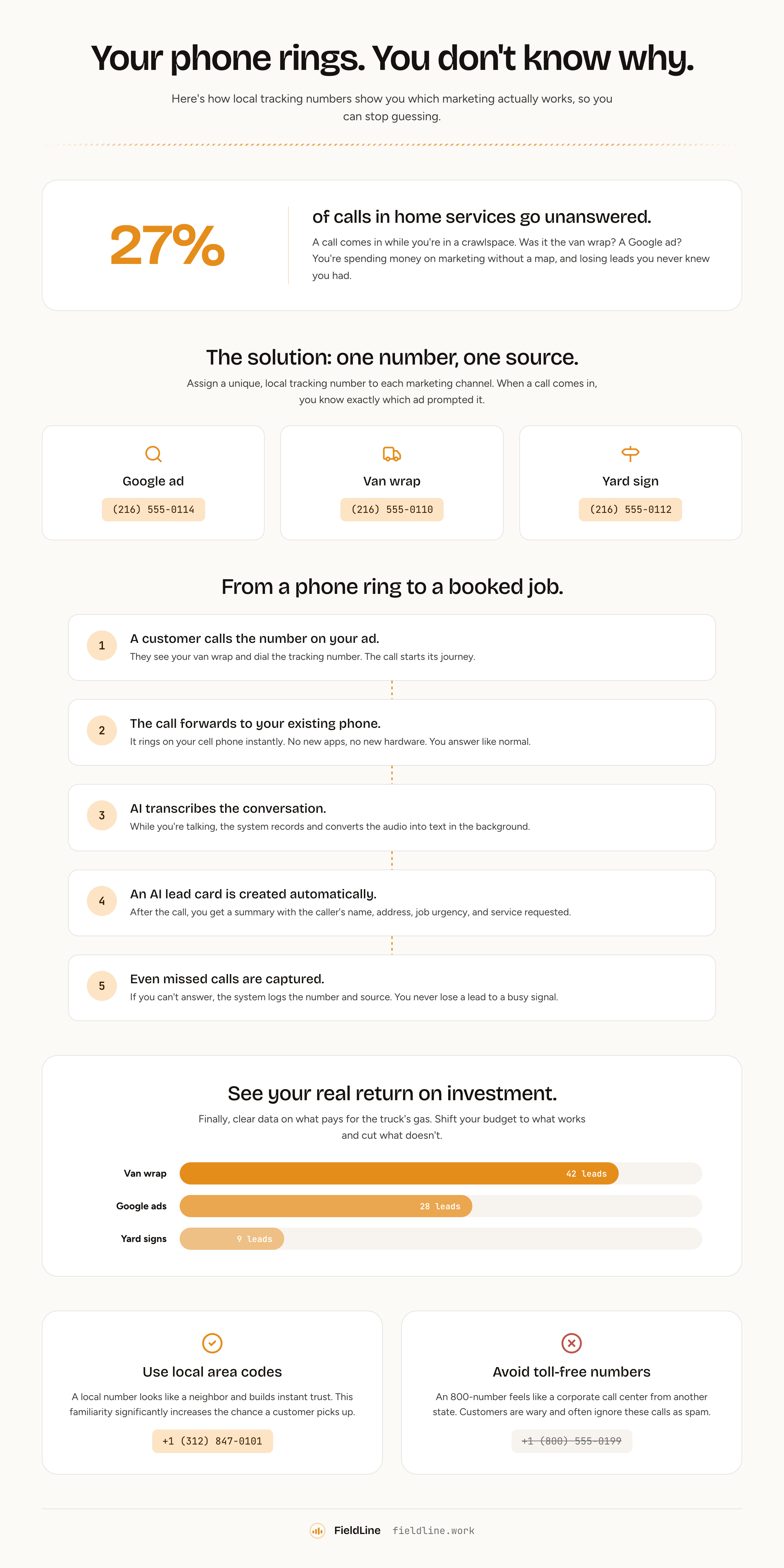
Effective tracking follows the "One Number, One Source" rule. You assign a unique number to each marketing asset. One for your Facebook page. One for your yard signs. One for your Google Local Services Ads. This setup makes local tracking numbers for service business operations clear and manageable. When a lead calls, you know exactly which ad prompted the dial before you even pick up. It eliminates the guesswork that usually comes with a marketing budget.
The path of a call: from ad to lead card
The process starts when a homeowner sees your number on a van wrap. They dial. The call is instantly routed to your personal cell phone or a technician's phone. There is no lag. You don't need a softphone or a new handset. While you are clearing a drain or inspecting a roof, the system works in the background. It records the conversation and uses AI to transcribe the audio into text.
Once the call ends, the system generates a lead card. This card includes the caller's name, their service address, and the urgency of the job. It turns a simple phone ring into a digital record you can review on the tailgate of your truck. If you miss the call, the system still logs the number and the source. Since 27% of calls in home services go unanswered, having this record ensures you never lose a lead to a busy signal. You can follow up as soon as you step out of the crawlspace.
Attribution without the headache
Linking calls to specific technicians helps you see who is booking the most jobs. You can track offline marketing like yard signs as easily as digital ads. This data shows you the real ROI of your spending. You will know if that expensive van wrap is actually paying for the technician's time or if it is just decoration. Using local tracking numbers for service business growth allows you to stop wasting money on quiet phones. Managing these lines also helps you stay compliant with FCC guidelines on robocalls by keeping your business communication professional and organized.
The best part is the zero-app workflow. Your crew does not need to learn new software or navigate complex menus. Leads go straight to their existing phones. It is a tool that fits into the daily routine of physical labor without adding mental load. You can check the pricing tiers to see which plan fits your current crew size and start tracking every lead today.
A homeowner with a flooded basement does not want a corporate headquarters. They want a tech in a truck. Toll-free numbers suggest a long wait time and a dispatcher in a different time zone. They scream "call center" to a customer who needs help right now. Using local tracking numbers for service business growth works because they signal proximity. They tell the customer you are part of the community. You are the pro who knows the local building codes and the common issues in their neighborhood.
Local numbers are also more cost-effective to maintain than toll-free lines. Many providers charge higher monthly fees or per-minute surcharges for 800-numbers. For a small crew with 2-15 techs, these costs add up. Lower overhead means more profit on every service call. You get the data you need without the "big-box" price tag or the corporate image.
The 'Neighbor' factor in emergency services
When a Carrier furnace dies at 3:00am, friction is the enemy. A local area code reduces that friction. It implies a faster response time. Customers prioritize proximity when they are in a crisis. They assume a local pro can get there before the pipes freeze or the house overheats. Using a local area code significantly increases the likelihood of a customer clicking the call button compared to a toll-free alternative.
Avoiding the 'Call Center' stigma
Toll-free numbers make you look like a faceless corporation. You lose the small-business feel that builds long-term loyalty. Homeowners want to support local operators. They want the steady hand of a veteran who understands their specific town. You can use high-tech tracking without losing that personal touch. It keeps your business grounded in the physical reality of the neighborhood.
Every answered call is a chance to build a relationship. Local tracking numbers ensure your callback appears as a familiar number on the customer's screen. People are more likely to pick up a call from a local area code than an anonymous 800-number. This leads to higher booking rates and fewer wasted leads. You keep the regional identity that makes your business stand out in a crowded market.
Maintaining local tracking numbers for service business listings also helps your digital presence. Google favors consistency in your phone numbers. Using a local number that matches your service territory reinforces your relevance in local search results. It tells search engines exactly where you operate. This alignment helps your Google Business Profile rank higher when neighbors search for emergency repairs.
Deploying tracking numbers across your marketing channels
Identify your top three lead sources today. For most pros, it is Google, your van wraps, and your yard signs. Assign a unique number to each of these assets. Place the numbers prominently where they cannot be missed. A number on a van needs to be readable from three lanes away. A number on a yard sign needs to be clear from the sidewalk. Using local tracking numbers for service business marketing only works if the customer can actually see the digits.
Monitor your dashboard daily. It is a simple list of which lines are ringing. This is real-time data from the field. It is not a guess based on a customer's fuzzy memory of where they saw your name. Use this call volume to adjust your ad spend. If your Facebook ads are silent but your yard signs are blowing up, move your money to the signs. Stop funding the channels that do not make your phone vibrate while you are on a job.
Tracking offline assets: Yard signs and van wraps
Yard signs are a goldmine for HVAC contractors. They build trust because they show you are already working for a neighbor. While you are in a crawlspace or on a roof, that sign is your silent salesman on the lawn. Assign a dedicated number to your signs to see exactly how much work they generate. You might find that a $10 sign outperforms a $500 digital ad.
Van wraps are a major investment for any fleet. You might have different designs or different trucks for different services. Assign a unique local tracking number to each wrap style. You will learn which graphics actually drive calls and which ones are just expensive decorations. This same logic applies to direct mail flyers. Put a specific number on every batch to track your response rates by zip code or neighborhood.
Optimizing digital spend for plumbers
Digital marketing is often where small businesses lose the most money. Optimizing digital spend for plumbers requires knowing the difference between a click and a customer. Use tracking numbers in your Google Local Services Ads. Differentiate these high-intent leads from your Facebook ads or organic search results. You need to know if a lead came from a paid search or a free map listing.
Some keywords are expensive. You might pay a premium for "emergency water heater repair." Local tracking numbers for service business campaigns show you if those expensive clicks turn into actual conversations. If a keyword drives traffic but the phone stays quiet, stop bidding on it. It is a simple way to protect your profit margins and keep your marketing budget focused on results.
View pricing and start tracking leads
FieldLine: The no-nonsense phone line for your business
Running a small crew is chaotic enough. You don't need a complex software suite that takes a weekend to learn. FieldLine is a specialized instrument built for home-service operators. It is the phone line that runs the business while you are in the field. The setup takes two minutes. You buy a local number, assign it to a technician's personal cell, and go. There is no new hardware to buy and no softphone app to install. It is a tool designed for the reality of physical labor.
AI is not a luxury feature here. It is included on every tier. Every answered call is recorded and transcribed. You get an AI-generated lead card with the caller's name, their service address, and the urgency of the repair. Missed calls are logged with the source and number so you can follow up immediately. Pricing is month-to-month with no setup or cancellation fees. You can choose the Starter ($35/mo), Pro ($116/mo), or Scale ($287/mo) plan based on your current crew size. This pragmatic approach allows you to focus on the work instead of the bill.
Automatic lead capture for electricians
When you are balancing on a ladder at 10:00am, you cannot stop to take notes. AI extracts the critical details for you. It identifies the customer and their specific problem from the conversation. You receive these lead notifications directly on your existing cell phone. It keeps your workflow clean. You can review how your crew handles calls without listening to hours of audio. The AI summaries show you who is booking jobs and who is letting leads slip away. It is a steady hand in a high-pressure environment.
Scaling your shop without the software bloat
Many roofers choose FieldLine because it avoids the complexity of a full CRM. You don't need a bloated system to manage local tracking numbers for service business growth. You just need to know which ads are ringing the phone. It allows you to scale your shop without adding unnecessary mental load to your team. They stay focused on the roof while the system handles the lead capture in the background. You can start your 7-day free trial today and see the results on your own dashboard. It is time to stop guessing and start measuring what matters.
Stop wasting your marketing budget
You now have a clear blueprint for tracking every lead that hits your phone. Local numbers signal you are a neighbor, not a corporate office. They help you identify exactly where your leads come from while you are working in crawlspaces or sitting on truck tailgates. Using local tracking numbers for service business growth ensures you stop funding ads that do not ring your phone. You can finally see the real return on every yard sign, van wrap, and digital campaign without the usual guesswork.
AI-generated lead cards are included on every plan to keep your crew organized without the mental load of new software. FieldLine is built specifically for crews of 1 to 15 technicians who value utility and results. There are no setup or onboarding fees to slow you down. It is a steady hand for your operations that respects your time and your budget. Start measuring what matters and get back to the job site with total confidence in your marketing spend.
Frequently asked questions
Keep reading
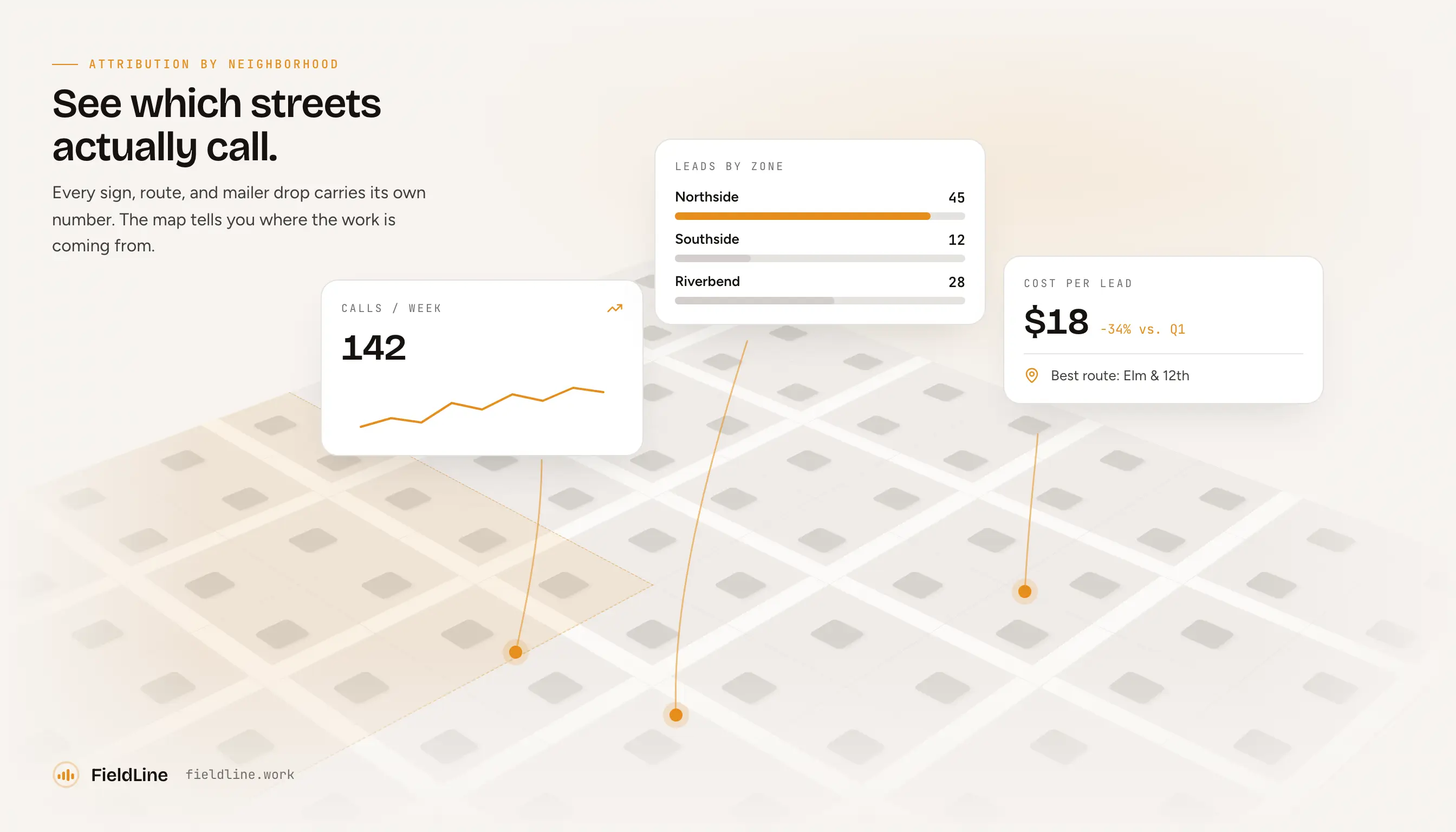
Track Leads from Yard Signs: Home Services Guide (2026)
Tired of guessing which signs work? Learn to track leads from yard signs with a simple system. See your real ROI and stop wasting money on dead zip codes.
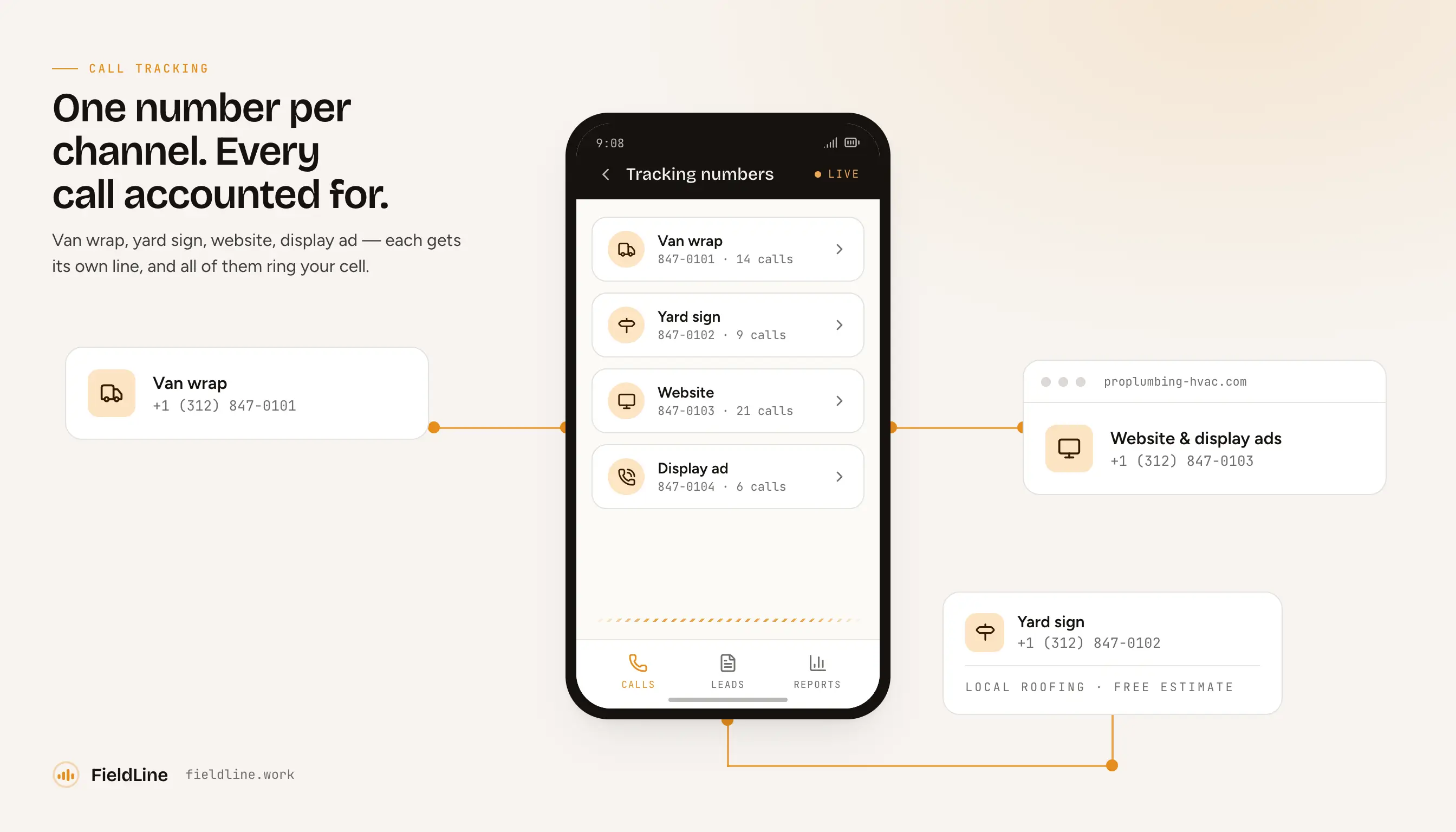
HVAC Advertising Tracking Numbers: Stop Wasting Your Ad Budget in 2026
Stop guessing if your ads work. Use hvac advertising tracking numbers to see which campaigns drive calls and prove your ROI. Capture every lead, even in a cr...
Stop guessing which calls turned into jobs.
FieldLine gives every channel and every tech their own number, records and summarizes each call, and turns it into a lead card you can act on. 7-day free trial, no card required.